Water Stains and Dark Spots on Hardwood Floors
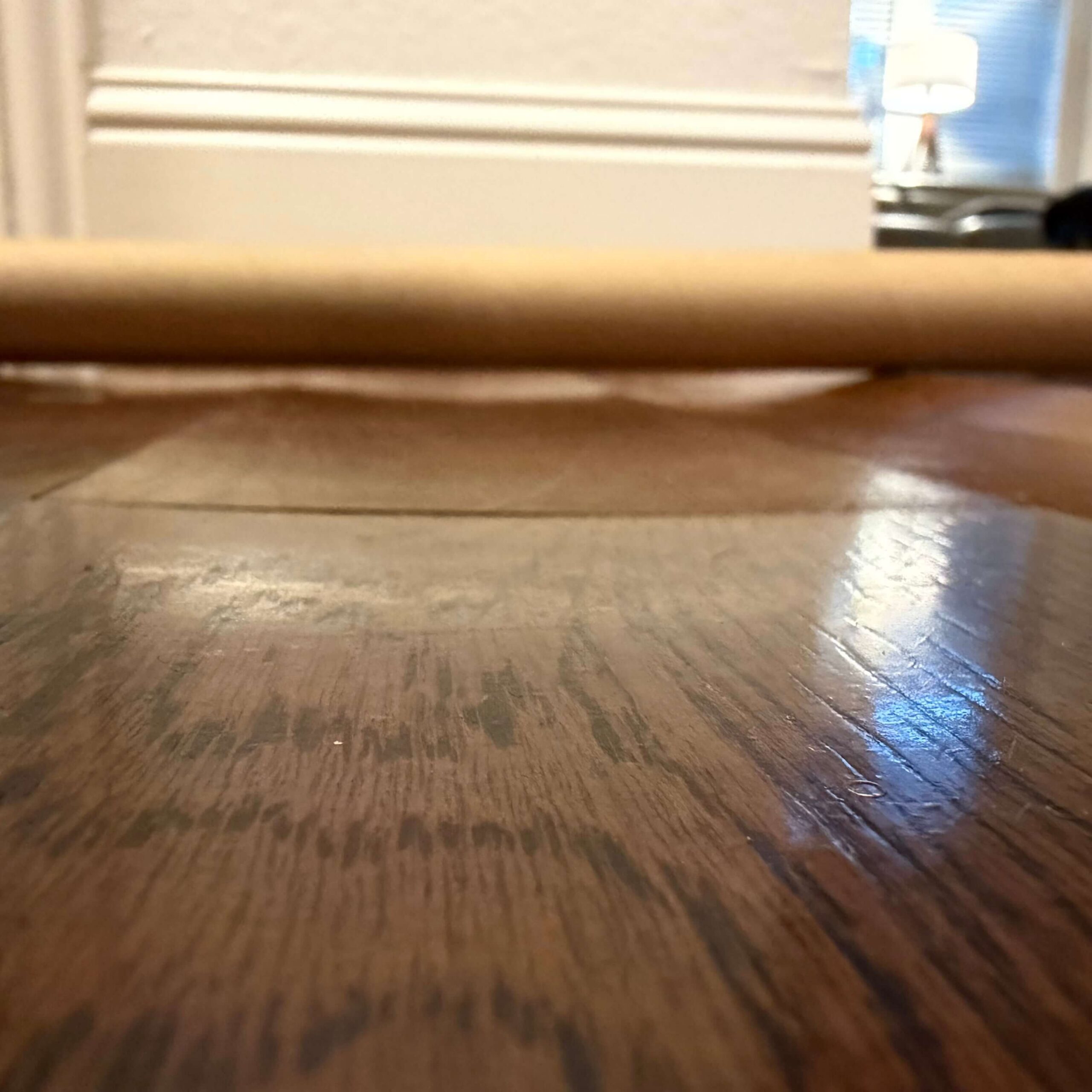
The quick answerThe mark’s color tells you how deep the water got. White or cloudy spots sit in the finish and usually sand out in a single pass. Gray means moisture reached the wood fiber and often lifts with a full sanding. Black staining has penetrated deep and often won’t come out at all.
Why Does Color Tell You the Depth?
A finished hardwood floor has layers, and water leaves a different signature in each one. Reading the color is a shortcut to knowing which layer you are dealing with, which determines whether the fix is an afternoon job or a project.
This is also why a homeowner and a flooring professional can look at the same mark and reach opposite conclusions. A dark spot that looks catastrophic may be shallow, and a faint gray haze may be the visible edge of something much larger underneath.
What Do White or Cloudy Marks Mean?
White rings and hazy patches are moisture trapped inside the finish rather than in the wood. A wet planter, a pet bowl, or a glass left overnight will do it, and so will mopping with too much water.
These are the best-case scenarios. The wood underneath is untouched, and the mark disappears as soon as the finish comes off. On a floor that is otherwise in good shape, this often means a screen and recoat rather than a full sanding.
If white marks appear regularly across a floor, the finish may be worn thin enough that it no longer seals. That is a maintenance signal worth acting on before the next spill reaches the wood, and it is covered in our homeowner’s guide to refinishing.
What Does Gray Discoloration Mean?
Gray means the water got past the finish and into the wood fiber. The wood has begun to break down at the surface, which is a chemical change rather than a stain sitting on top.
Most gray discoloration is shallow and lifts within the first two passes of a full sanding. This is very common near exterior doors, around sinks, and in front of refrigerators, where small amounts of water reach the floor repeatedly over years.
Gray that appears suddenly across a defined area is different. That usually indicates a single water event rather than slow accumulation, so check for cupping and take a moisture reading before assuming it is only cosmetic.
Not sure how deep your stain goes?
A test sanding and a moisture reading show whether the mark is in the finish, the wood, or something below it.
Why Is Black Staining So Difficult?
Black marks are usually tannin in the wood reacting with iron and moisture over time. Oak is high in tannin, which is part of why this shows up so often on oak floors common throughout North Texas homes.
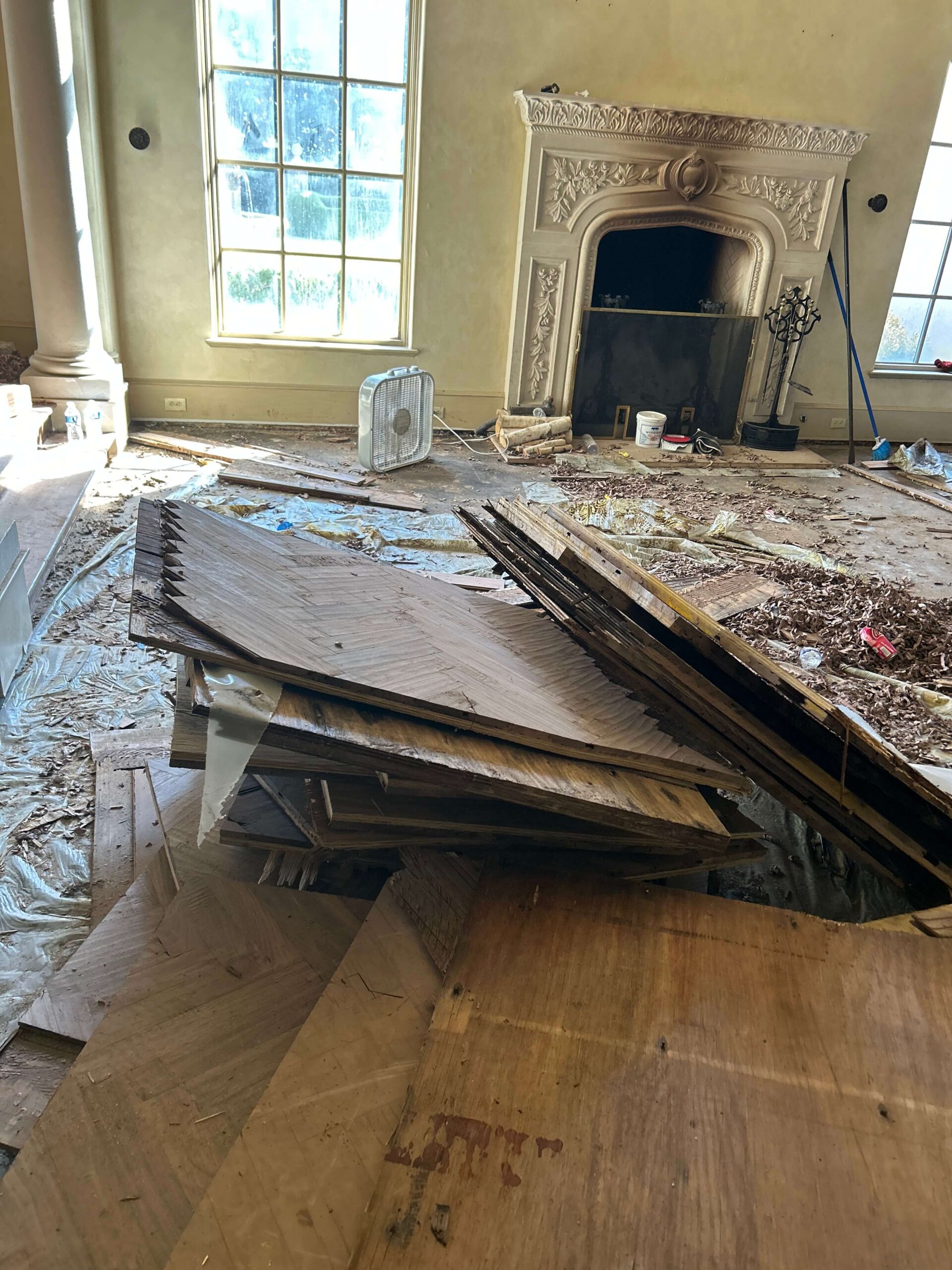
Water damage on a custom walnut pattern floor.
The reaction does not stay on the surface. It follows moisture down through the wood, which means the discoloration can run through most or all of the thickness. Sanding removes the top and reveals more of the same color underneath.
Bleaching agents can lighten black staining, and they occasionally work well enough on an isolated mark. The complication is that treated wood accepts stain differently than the wood around it. You can end up with a pale patch instead of a dark one, which is not obviously an improvement.
Black staining that spreads, smells musty, or sits next to soft areas is a different problem entirely. That combination points to moisture still present underneath, and the priority shifts from appearance to finding the source. Our article on the warning signs of mold beneath hardwood explains what to look for.
What About Dark Spots With No Obvious Cause?
Pet accidents produce a stain that behaves much like black water staining, because urine drives the same tannin reaction and adds salts that penetrate further. These are among the hardest marks to remove and frequently require replacing the affected sections.
Staining that appears along a wall, under a window, or in a straight line often marks a path rather than a spill. Water travels along the length of the flooring and follows framing below, so a line of dark marks is worth investigating even when the floor feels dry.
When the cause isn’t obvious, a moisture reading can settle it quickly. Readings taken on the flooring and the subfloor during a walkthrough usually identify whether a stain is history or an active problem, and staining tied to a plumbing or appliance failure is handled differently than a surface mark, as we explain in our step-by-step guide to restoring a floor after a leak.
Dark marks spreading with no clear cause?
We take readings on the flooring and subfloor to find out whether the stain is history or still being fed.
How Do You Fix Staining Without Making It Obvious?
Spot treating a stain almost always leaves a mark of a different kind. Sanded areas take stain differently than surrounding wood, and a patch that is technically clean still catches the eye from across the room.
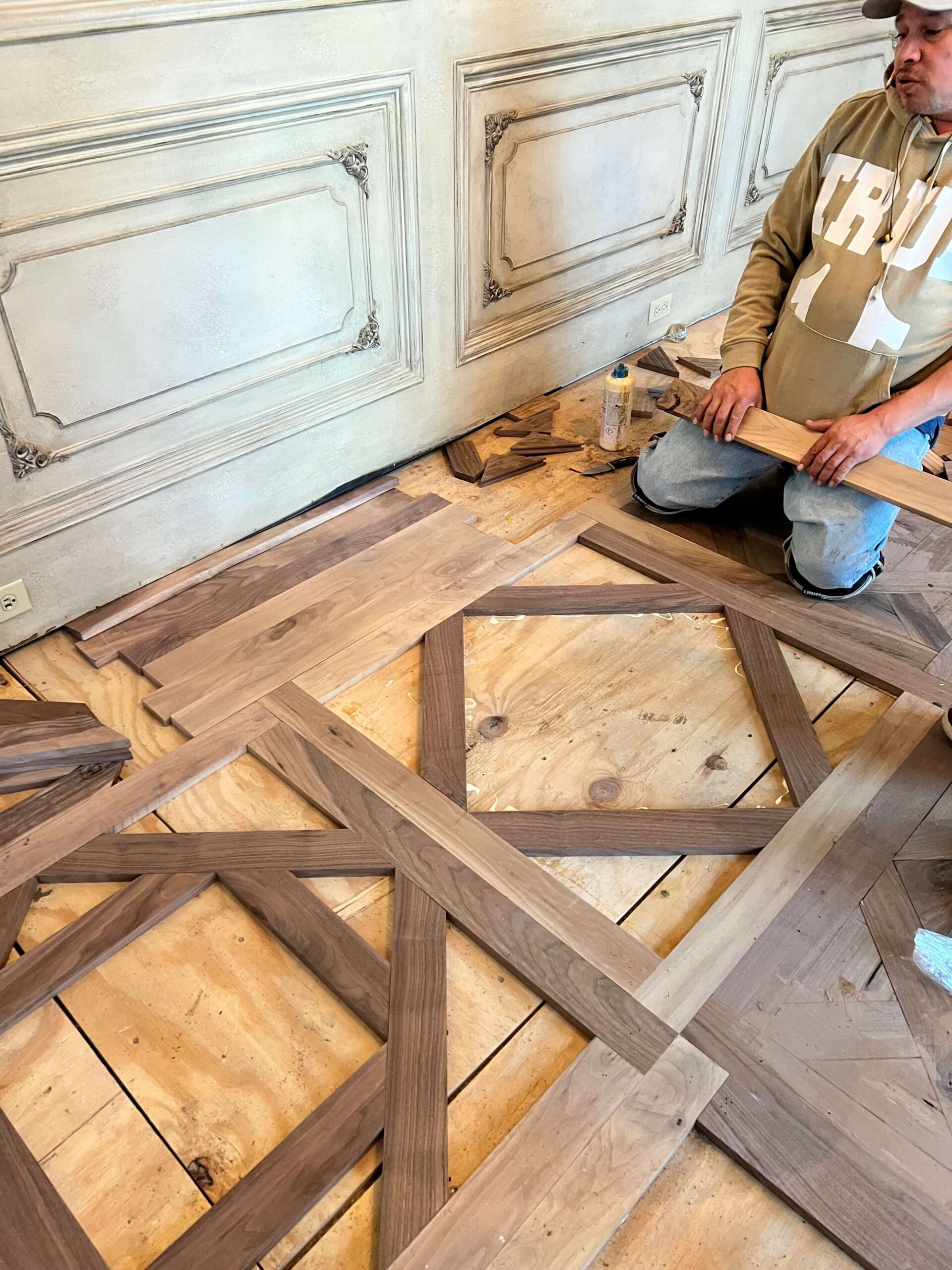
Repairing a custom Bordeaux pattern so the fix blends in.
The approach that works is to correct the damage and then sand and finish the entire connected area as one surface, so the repair has no edges to notice. Where sections had to be replaced, we blend new wood into the existing layout rather than dropping it in as a block.
We build the color on site to match your existing floor. That is what allows a repaired area to match a floor that has aged for years, and it is the same process we use when installing floors that have to match existing wood in an adjoining room or addition.
50+ yrsof experience behind our team
On-sitefinishing to match your floor
NWFAmember
Same weekconsultations typically
Have the Staining Looked At Before You Sand
A test sanding takes minutes and tells you whether a mark is shallow or permanent, which is the difference between a refinishing project and a replacement. Call (214) 399-1770 to schedule a consultation. We will test the affected area, take moisture readings, and give you a straight answer about what will and won’t come out. We handle whole-room and whole-floor projects across the Dallas and Fort Worth communities we serve.
Frequently Asked Questions
Will vinegar or baking soda remove a water stain from hardwood?
Household remedies sometimes help with a fresh white mark sitting in the finish. They do nothing for gray or black discoloration in the wood itself, and acidic mixtures can dull or damage the finish around the spot.
How long does it take for water to stain a hardwood floor?
White marks can form within hours. Gray discoloration usually takes repeated exposure over time. Black staining generally means moisture has been present for weeks or longer.
Can a single stained area be replaced without redoing the room?
The section can be replaced, but finishing only that section will show. In most homes, we replace the damaged area and refinish the connected space so the floor reads as one surface.
Does the species of wood affect how badly it stains?
Yes. Oak is high in tannin and shows black staining readily, while species like maple react differently. The differences between red and white oak also affect how a repaired area takes stain.
Is a dark spot worth calling someone about, or should I wait and watch it?
If it is spreading, darkening, or sits near an area that feels soft, have the damage assessed on site rather than waiting. You can book a walkthrough for stain and water damage repair and get a moisture reading before deciding anything.