Can a Water-Damaged Section Be Replaced to Match the Rest of the Floor?
The quick answerYou can match the wood by species, width, and grain. You can’t match the color by installing new wood next to an aged floor, because the existing floor has darkened over years of light exposure. Matching means refinishing the connected area so the whole surface reads as one floor.
Why Does New Wood Look So Different?
Wood changes color as it ages. Oak ambers, cherry darkens considerably, and every species shifts under years of daylight. A floor installed fifteen years ago looks different today than it did the week it went in.
New wood of the identical species from the identical mill starts where your floor started, not where it is now. Set them side by side, and the new section reads lighter and more uniform because it lacks the subtle variation that foot traffic and furniture create over time.
Stain narrows the gap but does not close it on its own. Applying the original stain formula to new wood produces the original color, which is not the color of the floor it has to match.
What Does Real Matching Involve?
The replacement wood is cut into the existing floor with staggered seams so the repair has no rectangular outline. Rows are woven rather than butted, which is the difference between a repair you cannot find and a patch everyone notices.
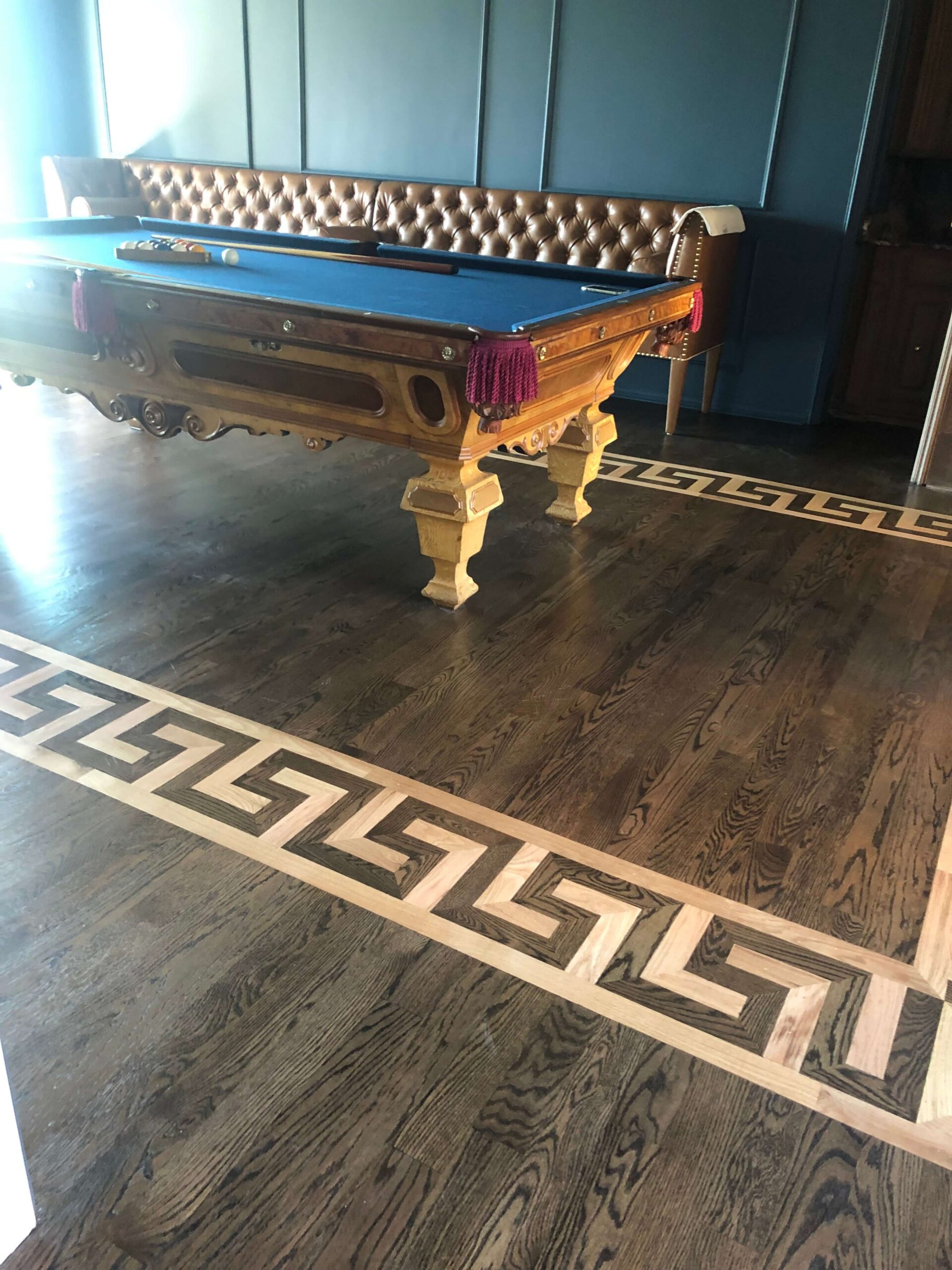
Finished result after a water damage repair.
Then we sand the connected area into one surface. This removes the existing finish and aged surface layer, bringing the old wood and the new wood to a common starting point.
Color is built from there, on site, in layers, tested against the floor rather than chosen from a sample. This step does the real work, and it is why blending replacement wood into an existing floor is a different job than simply installing new flooring. It is also the main advantage of finishing hardwood on site instead of buying it prefinished.
Worried a repair will show?
We will look at your floor’s species, width, and color and explain what a seamless match would take.
How Large Does the Refinishing Area Need to Be?
This question determines project size, and the answer is set by sight lines rather than where the damage stopped.
A floor that runs continuously from a kitchen through a dining room and into an entry is one visual surface, even though it is three rooms. Refinishing only the kitchen leaves a color break at an opening where the eye expects continuity. The same logic applies between levels when a leak upstairs damages the floor below and a shared staircase connects them.
When a doorway, threshold, or change in direction interrupts the run, the break is natural, and the refinishing area can stop there. During a consultation, we walk the connected space and identify where a stopping point will read as intentional.
What If the Original Wood Is No Longer Available?
This comes up with older floors, discontinued profiles, and unusual widths. Species is usually obtainable. Exact width and profile sometimes are not. Grade matters too, since the amount of knots and character in new material should match what is already there.
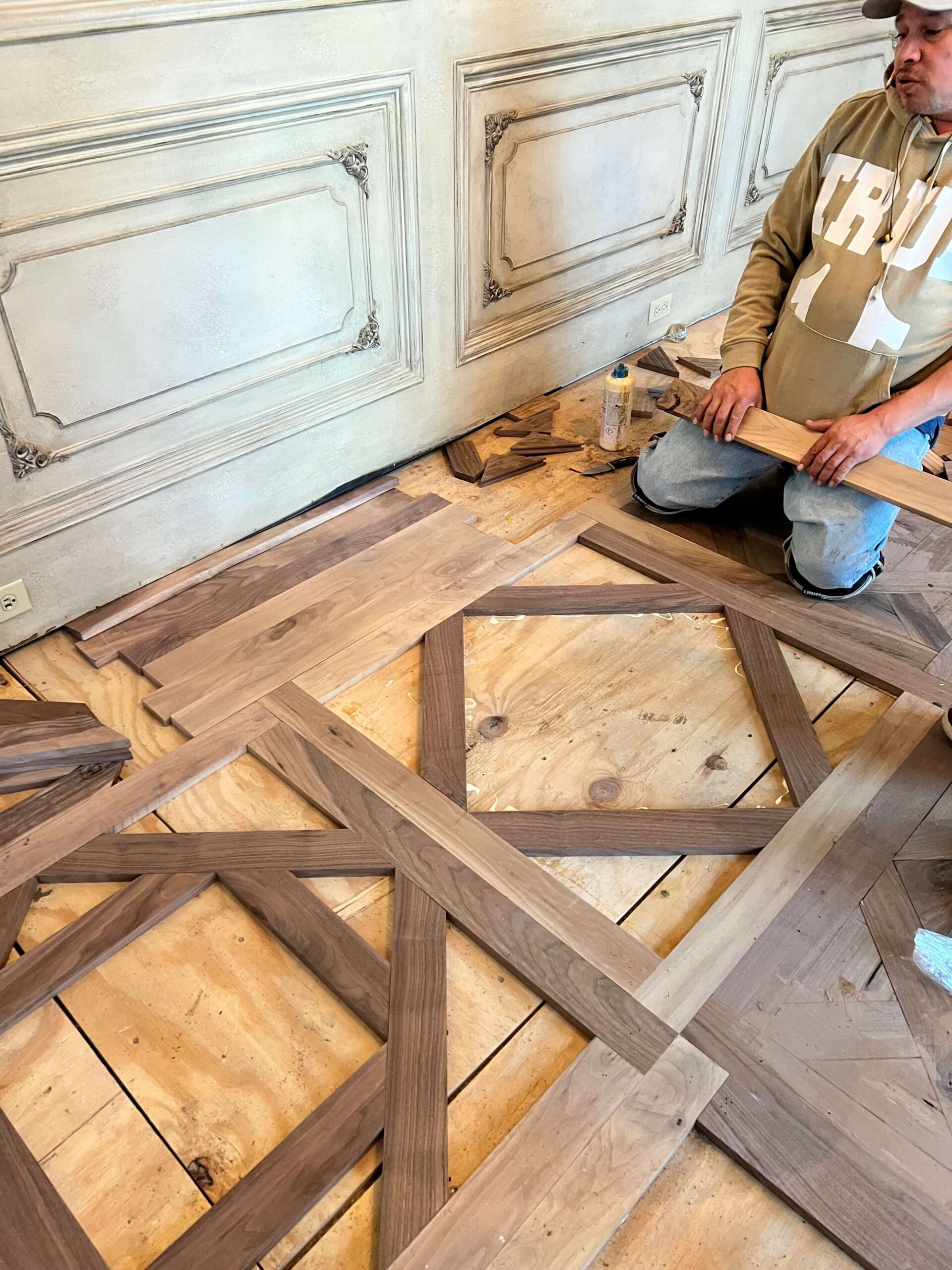
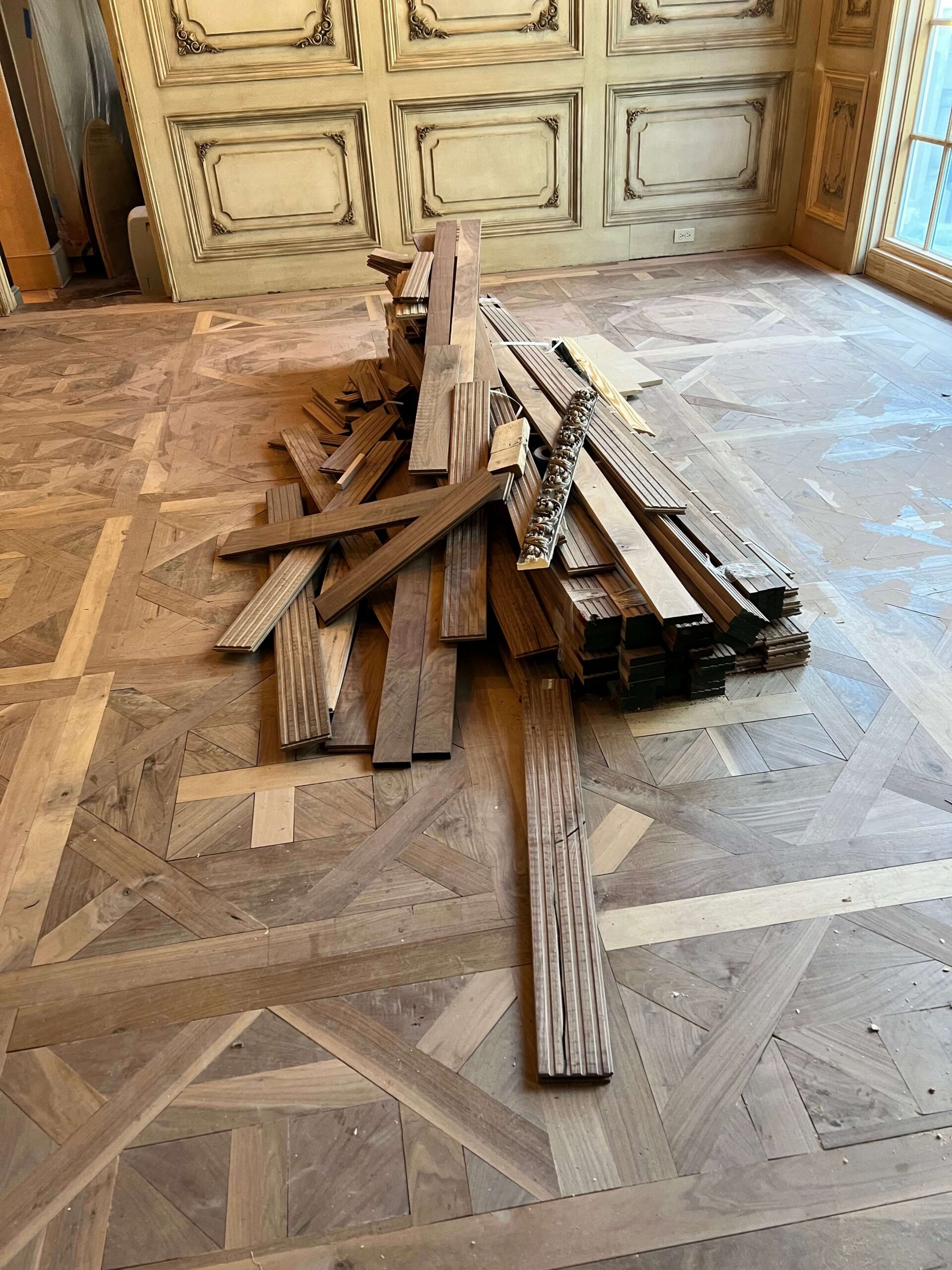
Repairing a custom Bordeaux pattern after a leak.
Where the original is unavailable, wood can be milled to the existing dimensions. It costs more than stock material and takes longer, and for a large damaged area it is often the difference between a repair that works and one that never quite settles.
Occasionally the better answer is to source material from a closet, a pantry, or an area under permanent furniture, use that original wood in the visible space, and put new material where nobody looks. It is an old trick and it still works well.
Original wood discontinued?
We can source, mill, or borrow material to match your floor, and we will tell you which approach fits your home.
When Is Replacing the Whole Floor the Better Call?
When the damaged area is large relative to the room, when the existing floor has already been sanded to the limit of its remaining thickness, or when the profile cannot be reasonably matched, replacement is sometimes the more sensible path.
A floor also has a finite number of refinishes in it. A solid three quarter inch floor can generally be sanded three to four times across its life, so a floor that has been refinished repeatedly may not have material left for another pass. Our breakdown of how to judge whether a floor is worth saving covers where that line falls.
Find Out How Far the Finishing Needs to Reach
The difference between a repair that disappears and one you notice every day is usually decided before any work starts, in the decision about how much area gets finished. Call (214) 399-1770 to schedule a consultation. We will look at your existing wood, identify where the natural stopping points are, and show you what matching will actually require. We typically schedule consultations within the same week.
Frequently Asked Questions
Can you match a floor without refinishing any of the existing wood?
Occasionally, on a floor that is still very close to its original color or in a small space with a natural visual break. In most homes with an aged floor, the honest answer is no.
How long does a section replacement with refinishing take?
The replacement itself is typically a day or two. Sanding and finishing the connected area adds several days, with drying time between coats that cannot be shortened.
Will the repaired section age the same way as the rest?
Yes. Once everything carries the same finish, the whole floor ages together from that point forward, and any small remaining difference narrows over the following year.
Does this work the same on engineered flooring?
The principle is the same but the limits are tighter, because an engineered floor can only be sanded as far as its wear layer allows. We cover that in our article on saving engineered floors after water damage.