Plainsawn vs Rift and Quartersawn White Oak
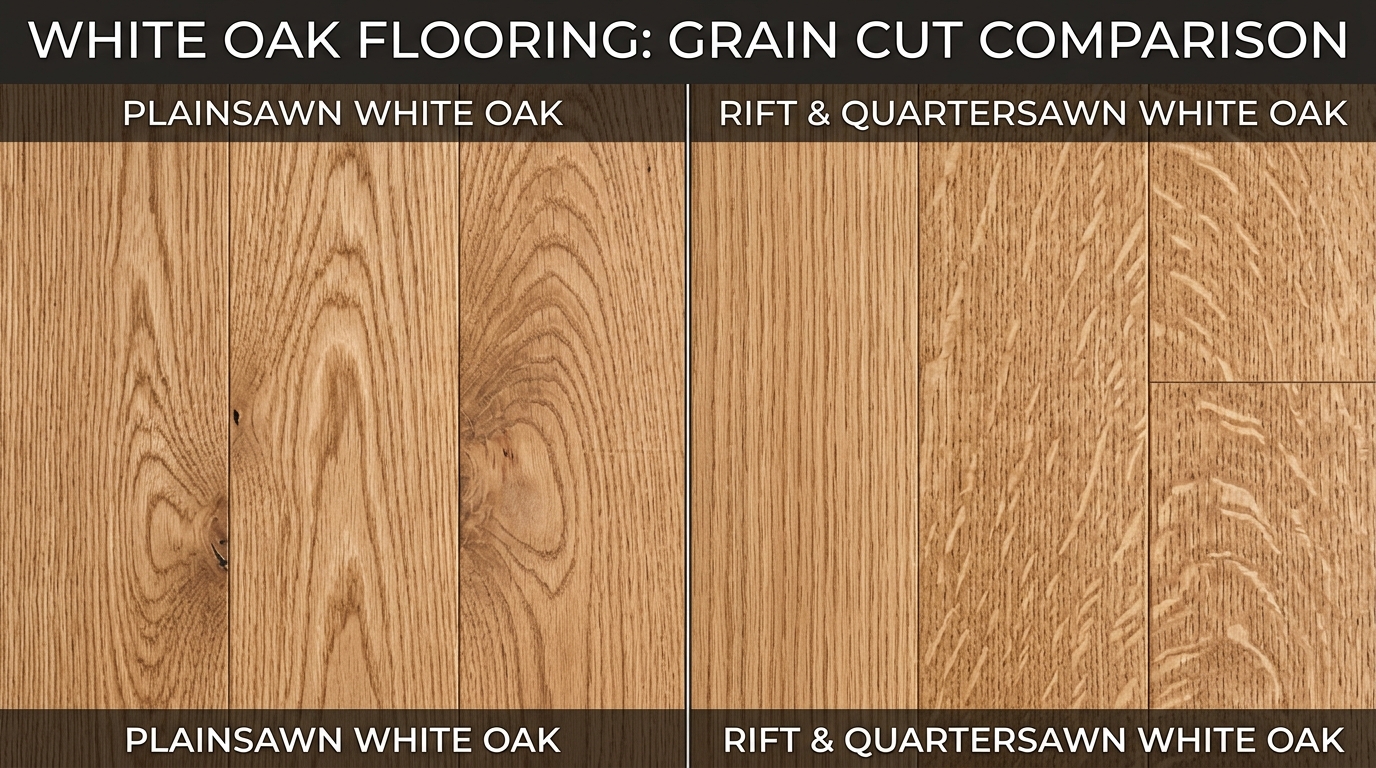
The quick answerPlainsawn produces the familiar cathedral arch grain and is the most economical because it yields the most usable plank from a log. Quartersawn produces straight vertical grain with visible ray flecking. Rift produces the straightest, quietest grain of all and the least yield, which is why it costs the most.
These are three ways of cutting the same log, and the cut determines what the plank looks like and how it moves. Rift and quartersawn are also meaningfully more dimensionally stable, which is why they show up in wide plank specifications.
What Is the Difference Between Plainsawn, Rift, and Quartersawn?
Picture the growth rings as circles at the end of a log. The angle at which the saw crosses those rings is the whole story.
- Plainsawn, sometimes called flatsawn, cuts straight through the log in parallel slices. The rings meet the face of most planks at a low angle, under thirty degrees, producing the looping cathedral pattern.
- Quartersawn cuts the log into quarters first, then slices each quarter so the rings meet the face at sixty to ninety degrees. The grain runs straight up the plank, and in white oak the medullary rays are exposed as flecks and ribbons across the face.
- Rift cuts at roughly thirty to sixty degrees to the rings, deliberately avoiding the ray fleck. The result is the straightest, most uniform grain available, with no cathedraling and no flecking.
Rift and quartersawn are usually sold together as a mixed product, commonly abbreviated R and Q, because both come off the same quartering operation.
What Does Each White Oak Cut Look Like on the Floor?
Plainsawn gives a floor movement and variety. In a traditional interior, it reads as warm and familiar. Across a wide open floor, the cathedral figure repeats often enough that some people find it busy.

Grain is easiest to judge on full planks, side by side.
Quartersawn reads as more formal and more crafted. The ray fleck is the signature of Arts and Crafts era interiors, and it is why the original floors in the older Park Cities and Swiss Avenue houses look the way they do. Homeowners planning hardwood floor installation in Preston Hollow often consider quartersawn for that same crafted look.
Rift is the quietest of the three. Long straight grain, no figure competing for attention, which is exactly why it dominates contemporary wide plank specifications. It is also the most forgiving background for a light or natural finish, since there is less grain contrast for the stain to settle into unevenly. Species plays a part too, and how white oak compares with red oak in color and hardness is worth settling before you choose a cut.
Which White Oak Cut Is Most Stable in Wide Planks?
Wood moves more tangentially than radially. Because plainsawn planks present the rings at a low angle, they move more across their width. Quartersawn and rift planks present the rings closer to perpendicular, so they move less across the width and slightly more in thickness, which nobody notices.
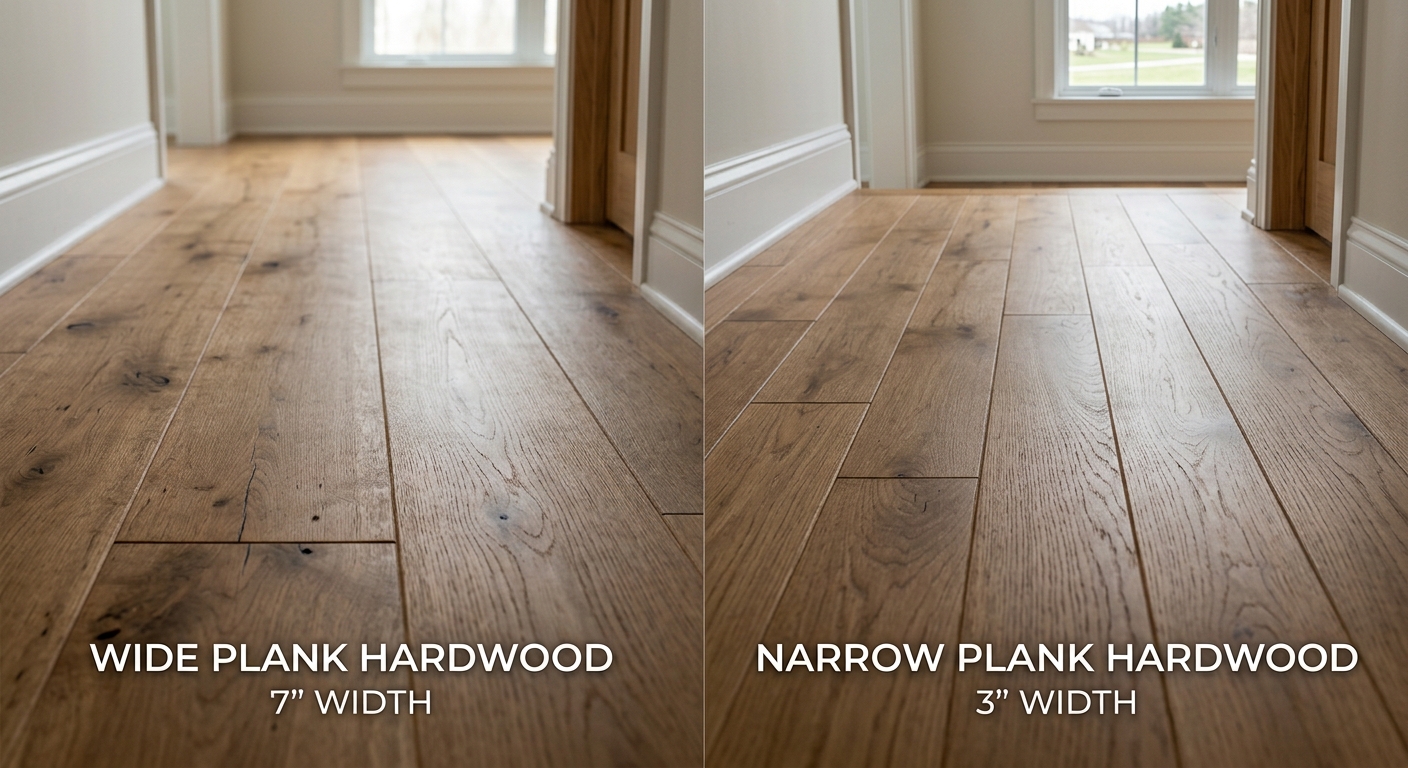
Seasonal movement adds up as plank width grows.
Roughly speaking, quartersawn moves about half as much across its width as plainsawn in the same species. In a 2 1/4 inch strip that difference is academic. In an 8-inch plank, it decides whether the floor gaps noticeably each February. Combined with how North Texas humidity swings through the year, that is the practical case for paying the premium at width.
Rift and quartersawn also cup less, which matters over any subfloor that is not perfectly flat and after any minor moisture event. If you are planning hardwood floor installation in Rockwall with wide planks, that stability is worth weighing early.
Planning a wide plank white oak floor?
We will help you match the cut to the plank width and to the way your rooms handle seasonal humidity.
How Do Cut and Yield Affect White Oak Flooring Price?
| Plainsawn | Quartersawn | Rift | |
|---|---|---|---|
| Ring angle to face | Under 30 degrees | 60 to 90 degrees | Roughly 30 to 60 degrees |
| Grain appearance | Cathedral arches | Straight with ray fleck | Straight, no fleck |
| Yield from a log | Highest | Lower | Lowest |
| Relative cost | Baseline | Higher | Highest |
| Movement across width | Most | About half of plainsawn | Similar to quartersawn |
| Cupping tendency | Highest | Low | Lowest |
| Suits wide plank | With careful control | Yes | Yes |
| Reads as | Traditional, warm, varied | Formal, crafted, period | Contemporary, calm, uniform |
Are rift and quartersawn worth it in your home?
We will show you where the extra stability earns its premium in your rooms and where plainsawn is the better value.
When Is Rift and Quartersawn White Oak Worth the Premium?
Width is the clearest trigger, so it helps to decide how wide your planks should be before you choose the cut. Once planks pass about six inches, the stability of a rift or quartersawn cut stops being a refinement and starts preventing the seasonal gapping that wide plainsawn shows in this climate. A light or natural finish is the second trigger, since even color needs even grain. In traditional widths under a warm stain, plainsawn gives you more character for less money and the premium is harder to defend.
The cut also interacts with grade. A rift and quartersawn select grade floor is about as clean and uniform as wood gets, and it is priced accordingly. Mixing a character grade with a rift cut sends contradictory signals, since one choice is asking for calm and the other for personality. Seeing the cuts against each other settles it quickly, and our appointment-only Dallas showroom keeps samples of all three.
650samples in our Dallas showroom
50+ yrsof experience behind our team
NWFAmember
3 generationsfamily-owned
The Cut Decides More Than the Look
Three planks from the same log can behave like three different floors, and at width that difference shows up every winter. Grain is also one of the few flooring decisions a photograph genuinely misrepresents. Call (214) 399-1770 or schedule a consultation, and we will bring plainsawn, rift, and quartersawn to the room they are going in, in the light they will live in.
Questions About Sawn Cuts
What do R and Q mean on a flooring specification?
Rift and quartersawn, sold as a mixed product. Both come off the same quartering operation, so mills typically bundle them. If you want rift only, with no ray fleck at all, it has to be specified separately, and it costs more again.
Is quartersawn oak worth the extra cost in a Texas home?
At width, generally yes. The reduced movement across the plank face directly addresses the seasonal gapping that wide solid plank shows in this climate. In 2 1/4 or 3-inch strips, the stability benefit is real but small enough that the premium is harder to justify.
Can you tell the cut by looking at a finished floor?
Usually. Cathedral arches mean plainsawn. Straight grain with flecks and ribbons across the face means quartersawn. Straight grain with no flecking means rift. In a mixed R and Q floor, you will see both of the latter two distributed through the field.
Does the cut change how the floor takes stain?
Yes, noticeably. Plainsawn has more open grain variation, so stain settles unevenly, and the cathedral figure becomes more pronounced. Rift and quartersawn take color more uniformly, which is one reason light and natural finishes are so often specified on them.